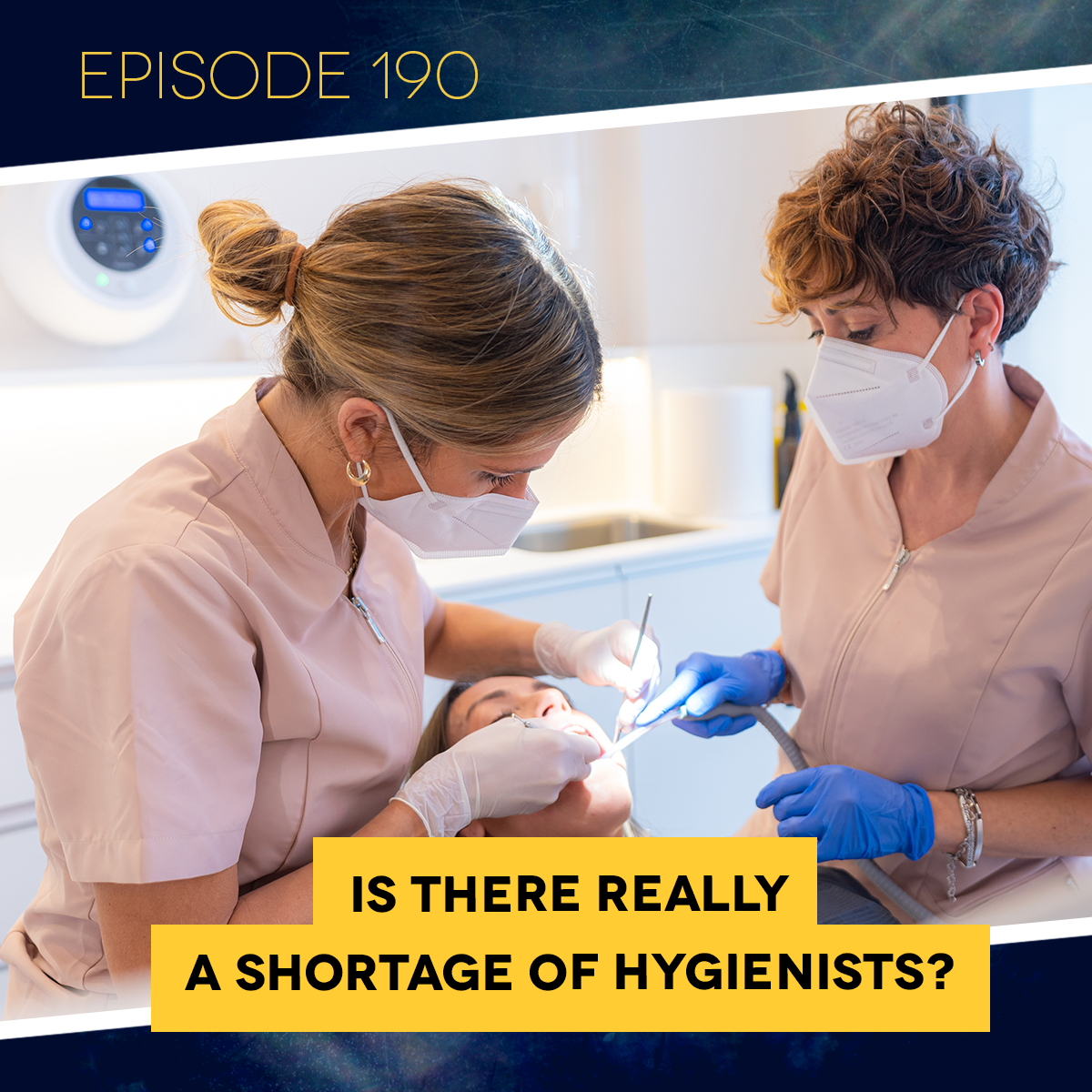
If you’ve been struggling to find (and keep) great dental hygienists lately, you’re not alone. In this episode, Jeff talks about the hygienist shortage that’s hitting practices hard in 2025. We’ll explore what’s behind it—from burnout and post-pandemic career shifts to fewer grads coming out of hygiene programs. Plus, we’ll share real-world tips on how to navigate the hiring crunch, keep your current team happy, and plan for the future.
MGE Power Program - https://www.mgeonline.com/power-program
Listen to full episode :




Have a question for Jeff?
Fill out the form and he will get back to you.
Questions From This Episode
Is there really a shortage of dental hygienists?
Nationally, yes. Jeff's math: there are about 160,000 general dentists in the US, and the ideal ratio is about 1.5 hygienists per doctor, which means roughly 240,000 hygienists. There are only about 212,000 to 214,000, down about 7,000 since 2019. On top of that, at least 30% work part-time. Some areas don't have a shortage, so check hygienist job ads on Indeed in your area for signing bonuses and rising pay.
Why aren't enough new hygienists entering the field?
Hygiene schools graduate about 8,000 to 9,000 hygienists a year, with 8,600 in the 2022 to 2023 school year. Meanwhile, 60% of hygienists are over 40, with an average age of 49 in that group, and 31% plan to retire in five years or less. To keep the workforce stable with modest growth, Jeff says schools would need to graduate close to 12,000 a year, about a 40% increase.
What can a dental practice do if it can't find a full-time hygienist?
Cover the days with a couple of well-trained part-time hygienists. Advertise in other parts of your state where there isn't a shortage and offer relocation, or look in nearby states with easy license reciprocity. If you still can't find anyone, Jeff suggests hiring an associate, preferably a new grad, rather than doing hygiene yourself. Assisted hygiene is another option, depending on your state's dental practice act.
What is assisted hygiene?
A hygienist works with a dental assistant, moving between rooms. The hygienist does the parts of the procedure only they can legally do, usually anything subgingival, like perio probing and scaling, while the assistant handles tasks they're allowed to do, such as polishing above the gumline or taking X-rays. That lets the hygienist spend about half an hour with each patient instead of a full hour. What's allowed depends on your state's dental practice act.
What are the long-term solutions to the hygienist shortage?
Jeff suggests talking to your state representative or state senator about adding hygiene programs, since they're far easier to reach than national politicians. Other ideas include promoting hygiene as a fulfilling career, accelerated tracks for experienced dental assistants, and a national licensure compact like the one for nurses, so hygienists can move between states more easily. Having a great work environment also helps attract hygienists who want to work full-time.
Episode Transcript
-
When was the last time you were looking for a full-time hygienist? Maybe you're looking for one now. If you are, or when you were, was that person tough to find? I know finding a part-time hygienist may be a challenge at times, but it's usually a heck of a lot easier. Normally, when you hear complaints about hygienist availability, it has to do with finding somebody full-time.
It's definitely tougher, in some cases tougher than finding an associate. Maybe we thought, "Well, you just need to look harder," or "You need to put more time into it," and those are valid arguments. But is this really a thing? Are there fewer hygienists than there should be? Well, I was doing some research recently for my upcoming presentation at our annual event, the MGE Owners Conference, where I usually do a whole presentation on the state of the profession.
I did a bit of a deep dive on just the subject of hygiene and hygienist availability, and what I found was kind of interesting. It answered the question, so I thought it would make a great episode. So for this week's episode, I'm going to share what I found. It answers this eternal question, which is on par with the meaning of life: why are hygienists so hard to find?
And I want to follow it up with what to do if you're having this problem in the short term, as well as some of the ideas out there for a long-term solution. My name is Jeff Blumberg, and I'm your host. Let me start with the simple answer to this question. Why are hygienists, especially full-time hygienists, so hard to find?
Because on a national US level, yes, there is absolutely a shortage of dental hygienists. Now, there are some regional aspects to this. I remember the first time I encountered this, years ago, probably close to 30 years ago. I was in the Chicagoland area, talking to a buddy of mine who's a dentist, and he mentioned that at that time, in the early '90s, the ratio was five dentists for every one hygienist.
So normally, when your hygienist had to take a day off and you needed to call in a temp, the temp agency was sending over a doctor. It was very rare to get an actual hygienist. You got a doctor, because there was such a shortage of hygienists. And you may be in an area where there isn't a shortage of hygienists. Usually the best way to find out, if you're advertising for a hygienist or you want to see what hygienist availability is like, is to go to Indeed and look at what the hygiene ads say.
If they have signing bonuses and they're paying $10 or $12 more an hour than they were two or three years ago, you probably have a shortage of hygienists in your area. If you don't see that, and the salaries look normal, then it's probably not a shortage area. So nationally, yes, there's a shortage, and I'll get into how I came to that conclusion in a second.
But regionally, you might be in an area where there isn't one. It really is area-dependent. All right, so let's look at the numbers. How did I come to the conclusion that we have a shortage? Let's first start with the supply of hygienists. I'm not going to read all these numbers to you, but let's start in 2015, when we had a little over 200,000 hygienists.
By 2017, we had 211,000. In 2019, we had 221,000. This is in the United States. So 221,000 in 2019. In 2022, which is the most recent number we have, there were 214,700. This comes from Becker's Dental, where they explain the numbers breakdown. So looking at just those two data markers, from 2019 to 2022, we've actually lost 7,000 hygienists. We're down to 214,000. Now, that number in a vacuum, with no other data, doesn't really mean anything. So let's compare it to the number of dentists we have and get an idea of how many hygienists we should have. Right now, there are about 203,000 dentists in the United States.
Twenty-one percent of those dentists are specialists. In most cases, maybe in a perio office, and I've seen the occasional orthodontist who has a hygienist. But for the most part, you're not going to get a lot of hygienists working in specialty offices. For the most part, they work for GPs. So if we have 203,000 dentists and 21% are specialists, that leaves us with 160,000 GPs.
So we have 160,000 GPs and 214,000 hygienists. Again, on its face, that doesn't look so bad, until we look at how many hygienists per dentist we should have, I guess is the best way of saying it. Let's first take a look at something I've covered in numerous episodes about building your hygiene program. If you have a general practice and you're retaining patients, it's a natural factor of expansion that your hygiene program is going to grow. I think I threw out some stats in a prior episode: if you were to start a scratch practice getting 30 new patients a month and retaining your patients, you should be adding about one to 1.4 days of hygiene per week every year. So after year one, you should have 1.4 days a week of hygiene. In year two, you should have almost three days of hygiene. By year three, you should have a full-time hygienist. By year 10, you should have close to 10 days of hygiene.
That's starting from scratch, 10 years later, with 30 new patients a month, which is not a huge number of new patients. So if your practice is growing geometrically as you retain patients, eventually you're going to hit a point where, as a doctor, it becomes inefficient.
You have too many hygienists. One doctor to two hygienists is, in my opinion, inefficient, because the doctor may be gloving and degloving several times per hour just to do exams. Usually the ideal sweet-spot ratio we've found is one to 1.5. So a doctor and one and a half hygienists works.
A doctor and three hygienists is not going to work. You probably need two doctors at that point, the doc and an associate. So if you have a GP practice, it's a natural fact of life that your practice should just grow. If you retain patients, there should absolutely be more hygienists than doctors, ideally one to 1.5. So if we have 160,000 GPs, how many hygienists is that? That's 240,000. Right now, we're at 212,000, so we're already almost 30,000 short right there. And let's assume that a large portion of these 160,000 general practitioners are full-time practitioners.
Of course, some are going to be part-time, but for the most part, they're full-time. But what about hygienists? This is where it gets interesting. A 2022 survey by DentalPost found that 40% of hygienists in private dental practices and 31% of hygienists in corporate dental practices worked part-time.
There was also a study done by the ADA Health Policy Institute in collaboration with the American Dental Assistants Association, the American Dental Hygienists' Association, the Dental Assisting National Board, and Ignite DA. That was quite a mouthful. Sorry, folks. It found that 53.7% of dental hygienists work full-time, meaning 32 hours or more per week. So if you take that 212,000, a little over 50% work full-time, so let's say 120,000 or 130,000 work full-time, and the rest work part-time. The actual statistic was a little bit funny, because 53.7% work full-time while 28.8% work part-time. I don't know what happened to the other 19%, but at least 30% of hygienists work part-time. That's 60,000 hygienists working less than 32 hours a week.
So we're already short 30,000 hygienists, and 30% of the ones we do have are working part-time. Then we move on to hygienist demographics, because the question is, okay, if we're already short hygienists, are we going to get a bunch of new ones soon? Well, not enough. And we also have a bit of a situation with the demographics.
The demographic data on age for hygienists is not as robust as it is for doctors, but here's what I did find. The average age for male hygienists is 43.3, and for female hygienists it's 42.2. I don't know what the male-to-female ratio is.
It's really not that big of a deal to me. They're both hygienists. So let's say the average age is in the 42 to 43 range. Now, 40% of the hygiene population is under 40, which means 60% is over 40, with an average age of 49. I'll say that again. Forty percent of those 212,000 hygienists are under the age of 40. The other 60% are over 40, and they have an average age of 49.
So if you look at working years, and again, I'm not practicing ageism, and as I've said before, I'm over 49, the point is that if somebody's 49, they're not planning on working another 30 years. That's just not where they're at. Someone who's 25 might be.
So more than half of the hygienists we have in the US are well over 40, closer to 50 years of age on average. And there was a survey done as part of the same study by the ADA Health Policy Institute and the assistants and hygienists associations.
One of the survey questions found that one-third of dental assistants and 31% of hygienists planned to retire in five years or less. This is all good news, isn't it? So let's summarize the workforce for a second. We have about 214,000 hygienists. Forty-two percent are under the age of 40.
Fifty-eight percent have an average age of 49. That's 116,000. And on average, many hygienists retire before the age of 65. So we have a lot of people exiting the profession at some point over the next five, 10, 15 years. Well, how many people do we have coming in to replace them? Here's where we get into the problem.
Here's the rub. The average number of graduates from hygiene school per year is between 8,000 and 9,000. As a matter of fact, the last three years it's been going up. It was averaging a little over 8,000 going into 2020, from 2018 to 2019 into 2020. It was like 8,200, 8,300 a year. It dropped under 8,000 in 2020, and now it's ramping back up. I don't have 2024 data, but in the 2022 to 2023 school year, we had 8,600 hygienists graduating.
But the problem is that the number of graduating hygienists entering the workforce will not keep up with the number of hygienists we may have leaving the workforce, especially when you consider how many hygienists tend to go part-time. As a matter of fact, to maintain the hygiene workforce at this point in time and have modest growth, we'd need to be graduating close to 12,000 hygienists per year.
That's about a 40-plus percent increase. So that's what's happening. There is a shortage of hygienists. As I said, it may be different regionally, but we are not producing enough hygienists to keep up with the exit rate being projected over the next few years, or even to keep up with the number of dental professionals we currently have. So the question is, let's say your practice is growing, and you don't want to stop that growth. You want to be able to add hygiene days and things of that nature. What do you do to find a hygienist beyond what you'd normally do, like placing an ad? Let's say placing an ad just isn't working.
You can always piece it together with a couple of part-time hygienists, and as long as you train them well, that can work. Maybe you don't get your full-time person, but at least you have your days covered. The other thing you can do: let's say you're in the state of Florida like I am, and you're in the Tampa Bay area like I am, and let's say there's a shortage of hygienists in this area.
Well, what I might do is advertise throughout the state. If I go to Miami, there may not be a shortage of hygienists. The relocation costs wouldn't be terrible. If I find somebody who works, I could bring them up and have them stay in one of these short-term residence-type hotels, like a Residence Inn, for a few weeks to see if they catch the vibe of the practice and we're doing well together. If they do, I can pay their relocation costs, bring them up to my practice, and work out some type of agreement in that regard. Maybe the area you're in is tight, but in other parts of the state, it's not.
And that works the other way too. You might be in a rural area, maybe upstate New York, and you're having trouble finding a hygienist. Just like with an associate, you can advertise in the city, and you might find one, no problem. This regional thing can really mess with your head to a degree.
I remember visiting a client's office in Manhattan a long time ago, 20-plus years ago. We were in Northern Virginia at the time, and there was a hygiene shortage there. And I remember being in this doctor's building in Manhattan, one of these high-rises with like 25 dentists in it, and there's this hygienist going door to door dropping off her resume.
I thought, wow, that would never happen in Northern Virginia. The first office she went to would say, "You're not leaving. You work for us now." So there is this regional thing. If your area is tight, look outside your area for an area that's not tight. Again, to me, the most real-time data is looking at something like Indeed and seeing what's being advertised.
So if I'm in Tampa Bay, I'd look at Indeed for Miami and go, "Hmm, it looks like hygienists down there aren't getting paid a lot. Why don't I advertise down there and move someone up to Tampa?" That's the first thing you might do. The other thing you could do is look for states that have easy reciprocity with your state.
You can go outside your state. Again, I don't know the reciprocity laws for each state, which is a whole other issue in and of itself. But let's say you're in Tennessee, and again, disclaimer, I don't know the reciprocity laws in Tennessee, but let's say it has good reciprocity with Georgia.
Let's say you're in southern Tennessee. You might find somebody in northern Georgia who wants to move to Tennessee. You could advertise in that area, assuming licensure isn't difficult to obtain. Now, if you just can't find anybody, the solution is not to do the hygiene yourself.
You're better off getting an associate, preferably a new grad, to do it until you can find one. Yes, that will be a bit more expensive. But there are pluses. In certain cases, if you're in a state that requires a doctor on site for the hygienist to practice, you don't need that with an associate doctor. That's a plus.
The other thing is that if it works out well and the practice continues to grow, that associate could eventually just start doing dentistry when you replace them with a hygienist. That's one solution. You can also do assisted hygiene. It's not my favorite, but it's better than emptying out your schedule.
How does that work? You basically have a hygienist working with a dental assistant, and the hygienist does the parts of the procedure that only they can do, which is usually anything subgingival. Again, look at your dental practice act. Do not take what I'm saying as the law. You have to look at what's legal and not legal in your state.
Full disclaimer there. But I remember that in certain cases, assistants can polish above the gumline and take X-rays, but the hygienist has to do the perio probing, the scaling, and things like that. So you flip-flop.
You have a hygienist and an assistant working together, flip-flopping from room to room, and that allows your hygienist to spend a half hour with each patient as opposed to a full hour. It's something you can do. There are different ways to set it up. It all depends on your state and its dental practice act.
The idea is not to slow your growth. That doesn't work. If you're retaining patients, hygiene should expand, so you have to make sure there's availability. You can't just say, "Well, I can't find hygienists." So that's the short-term solution. What's the longer-term solution? Well, the thing that's always confounded me is why we have a shortage of hygienists to begin with.
It's a two-year program, and it pays great. Someone is basically getting an associate degree and, in some cases, making $40, $50, $60 an hour. You'd think these programs would be full. Well, number one, there aren't enough hygiene programs. This is where you can talk to your local association or your state association, and you may zone out when I say that.
But let me tell you who you should talk to: your local and state politicians, especially your state politicians. I remember back during the pandemic, because everybody gets fascinated and fixated on national politics... And look, MGE is apolitical and nonreligious. We don't take a particular position.
We're all about helping you improve conditions in your dental practice. But the one thing I found, and I was guilty of it myself, was that I'd always get concerned about what was happening on a national level. The problem is, what am I going to do about things on a national level?
Not much of anything. But you can do things on a local and state level. It's very easy to get a meeting with your state rep. It's very easy to get one with your state senator. It's very easy to get a meeting with your local county commissioner. That's not difficult. And these are the people who actually control where you live.
So adding hygiene program availability, more education, and more healthcare availability, especially if you're in a state with a shortage of hygienists, is usually something one of these folks would be willing to talk to you about: your state senator or your state rep.
These are things they can help push through with various schools. It's definitely worth your time. And hygiene should be promoted as a fulfilling career, because it is. It's a good career. Another thing that could be done is accelerated tracks for dental assistants. Dental assistants, especially if they've worked in a practice for any length of time, have a degree of familiarity, so there are things they wouldn't have to learn from scratch when they start hygiene school.
You might have shorter programs for dental assistants, assuming they've met certain benchmarks. The state of Alabama has done this in one iteration or another for a long time, where essentially someone doesn't go to full hygiene school. You could look up the program for exactly how it works, because it's probably changed over the years. But they work under a doctor for a certain length of time, they have to take certain classes on infection control and things like that, and they eventually get licensed as a hygienist after a couple of years. They have to perform a certain number of cleanings and things like that in order to do it.
The problem is that license has zero reciprocity. You will never get licensed outside the state of Alabama with it. And funnily enough, you'd think that with that, the state of Alabama would have more hygienists than they know what to do with. They still have a shortage, because these hygienists need a doctor to practice with, and there aren't enough doctors in Alabama anyway. But that's something that could be done. The other thing you can do is just have a killer work environment, an environment where someone wouldn't want to not work there full-time. Be trained, be well organized, and do things like the MGE Power Program, where you're creating a fulfilling environment where people are productive.
I'll put a link to the Power Program on the episode webpage. The last thing I'd suggest is modernizing licensure. It's not as bad as for dentists, but reciprocity from state to state for hygiene licenses is pretty rough. There are some movements in progress right now, as of 2024 and 2025, similar to the nurse licensure compact, where basically someone is licensed nationally.
That would make life a lot easier, because imagine this for a second. You have a hygienist relocating to another state for whatever reason. Maybe they're moving because their spouse got a better job. Ideally, they should just be able to go work in a practice.
Maybe they have to register or apply ahead of time, and a background check is done on them. But assuming they have a license as a registered dental hygienist, you'd think they should be able to practice hygiene. So there should be better reciprocity, and those are things you could push for.
Like I said, on a state level, these are easy things to pass. You talk to your state rep, and they make it easy in your state to bring in hygienists. Funnily enough, Florida is notoriously bad at these things. Even as a dentist, you have to take practical boards if you come to Florida. You could have been practicing 30 years, and you have somebody watching you do a filling. It used to be on a person, and now it's on a mannequin of some kind, but you get the idea.
If you make that easier, it'll be easier for hygienists to move to other areas if they want to. But ultimately, even if hygienists can move, we need more of them. So anything you'd want to do or take on to help encourage more people to go to hygiene school and become hygienists, or to make it easier for assistants to become hygienists, I think is a good thing.
Anyway, not the usual episode this week. I saw this data and found it fascinating, because it's something I've heard off and on for years, and I finally got a chance to really look at the numbers. I found it interesting, and it answered some questions I had. I hope it did the same for you, and even better, I hope it gave you an idea of how to work through this if you're in a shortage area, as well as actions you can take as part of the dental profession to help push to relieve this shortage. So that's all I have for you this week, folks. Again, like I said, kind of a different episode. If you have any questions about MGE, you can find us online at mgeonline.com or call us at (800) 640-1140. I'll put a link to the MGE Power Program, like I mentioned earlier, on the episode webpage. Otherwise, folks, have a great week, and we'll see you at the next episode.